
What Is The Scrum Framework? This Might Surprise You!
What is Scrum? Well, without making things too complicated, the Scrum framework can be defined as the following:
Scrum is a lightweight, iterative framework for developing and delivering valuable products, including software.
Although Scrum is widely used in software engineering, people also apply this iterative, agile framework outside the software industry.
Most people in the IT industry believe that the term "Scrum" was coined early in the 2000s as a parallel track of emerging agile software development and delivery trends. That is a piece of incorrect information!
The Scrum metaphor appeared in a Harvard Business Review product-development article in January 1986. Hirotaka Takeuchi and Ikujiro Nonaka used it in their article: The New New Product Development Game. (Yes, two News) You should have a look at "The New New Product Development Game" to see how everything all about Scrum got started!
Scrum can be used in all kinds of software development projects. To develop and deliver complete software packages or only some modules of larger systems — both for products and services of internal and external clients.
The Scrum Framework is a lightweight process. It focuses on increasing the productivity of teams while reducing waste and redundant activities.
Scrum defines some general guidelines with a few rules, roles, artifacts, and events. Nevertheless, all of these components (Main Components of the Scrum Framework) are critical, serve for specific purposes, and they are essential for the successful use of the Scrum framework.
The main components of Scrum framework are:
- Three Accountabilities in the Scrum Team: The Product Owner, the Scrum Master, and the Developers.
- Five Scrum Events (Scrum Rituals) or Ceremonies: The Sprint, Sprint Planning, Daily Scrum, Sprint Review, and Sprint Retrospective. Scrum Grooming (Backlog Refinement) is an ongoing activity that supports these events, rather than a sixth formal event.
- Product Backlog (Scrum Backlog) or Scrum Product Backlog: An artifact that is used to manage and prioritize all of the known requirements of a Scrum project.
- Sprints: Cycles of work activities to develop shippable software product or service increments.
- Sprint Backlog: An artifact containing the Sprint Goal, selected Product Backlog items, and the Developers’ plan for delivering them.
- Increment: A usable product improvement that meets the Definition of Done.
Self-organization and unconditional collaboration are critical elements of the Scrum framework. Scrum Teams do no longer require a project manager in a classical sense. With Scrum, responsibilities traditionally assigned to a project manager are distributed across the Product Owner, Scrum Master, and Developers.
The Developers retain ownership of how they plan and carry out their work; the Scrum Master and Product Owner support that self-management. For instance, the Developers select Product Backlog items in discussion with the Product Owner and plan how to deliver a usable Increment.
Another central element with the Scrum framework is the continuous improvement that we enable with "inspect & adapt". A Scrum Team continuously monitors, inspects, and assesses their artifacts and their use of Scrum framework to adapt and optimize them. These continuous efforts for optimization maximize quality, efficiency, client satisfaction, and therefore minimize wastes and overall project risks.
The Scrum framework understands that the requirements are likely to change and they are not entirely known, especially at the beginning of projects.
Every project has unknown unknowns. Sometimes a few, sometimes a lot. The Scrum framework helps us embrace that we can discover and deal with these unknown unknowns only while we are running our projects.
The Scrum Team refines work before implementing it, with finer detail for higher-priority items likely to be selected sooner. During Scrum Grooming (Backlog Refinement) and Sprint Planning Meetings. Openness for change, continuous optimization, and learning from errors are now becoming integral elements of the whole software engineering lifecycle.
Another cornerstone of the Scrum framework is transparency and direct communication. The Scrum Product Owner works closely with the Scrum Team to identify and prioritize requirements. These requirements can be written as user stories and stored in the Scrum Product Backlog. The Scrum Product Backlog captures the known work needed to improve the product. It evolves as the team learns more.
A Scrum Team is empowered to select the user stories with which they are confident to deliver within a Sprint, often lasting two to four weeks and always one month or less. Because the Scrum Team commits its own goals, the team members feel more engaged, and they know that their opinions are listened to. This inclusion of Scrum team members to the natural flow and planning of software projects increases the team morale and subsequently augments the team performance.
Scrum Masters possess another vital role in the Scrum Framework as they work as servant leaders for and with their Scrum Teams.
Scrum Masters are trained facilitators to ensure flawless operation of their Scrum Teams. Sometimes they are master negotiators to protect their Scrum Teams from interruptions and fictive priorities of their stakeholders. Other times they are master communicators to remove or prevent known or anticipated impediments before these impediments bring their teams to dead-end streets. To only call a few of the responsibilities of Scrum Masters. We will cover more about the duties of various Scrum roles later.
The Scrum Framework, in its pure form, is best suitable for highly independent, one team green field or brown field projects.
However, the practical common sense of Scrum professionals did not stop there. With the introduction of additional roles and addendums such as "Chief Scrum Product Owner" and "Scaled Scrum", it can be used within different project configurations too, including multi-team and geographically distributed project setups. We will cover more about these as well.
For now, stay tuned and keep on enjoying the lecture!



We guarantee that your free online training will make you pass your Scrum and Kanban Certification Exam!
- 01
Register Online
Choose your Accredited certification and complete your registration.
- 02
Receive Your Access Code
Your personal exam access code is delivered instantly by email.
- 03
Prepare & Take Your Exam
Study your free training and answer 30 / 50 multiple-choice questions online, according to your program.
- 04
Earn Your Lifetime Credential
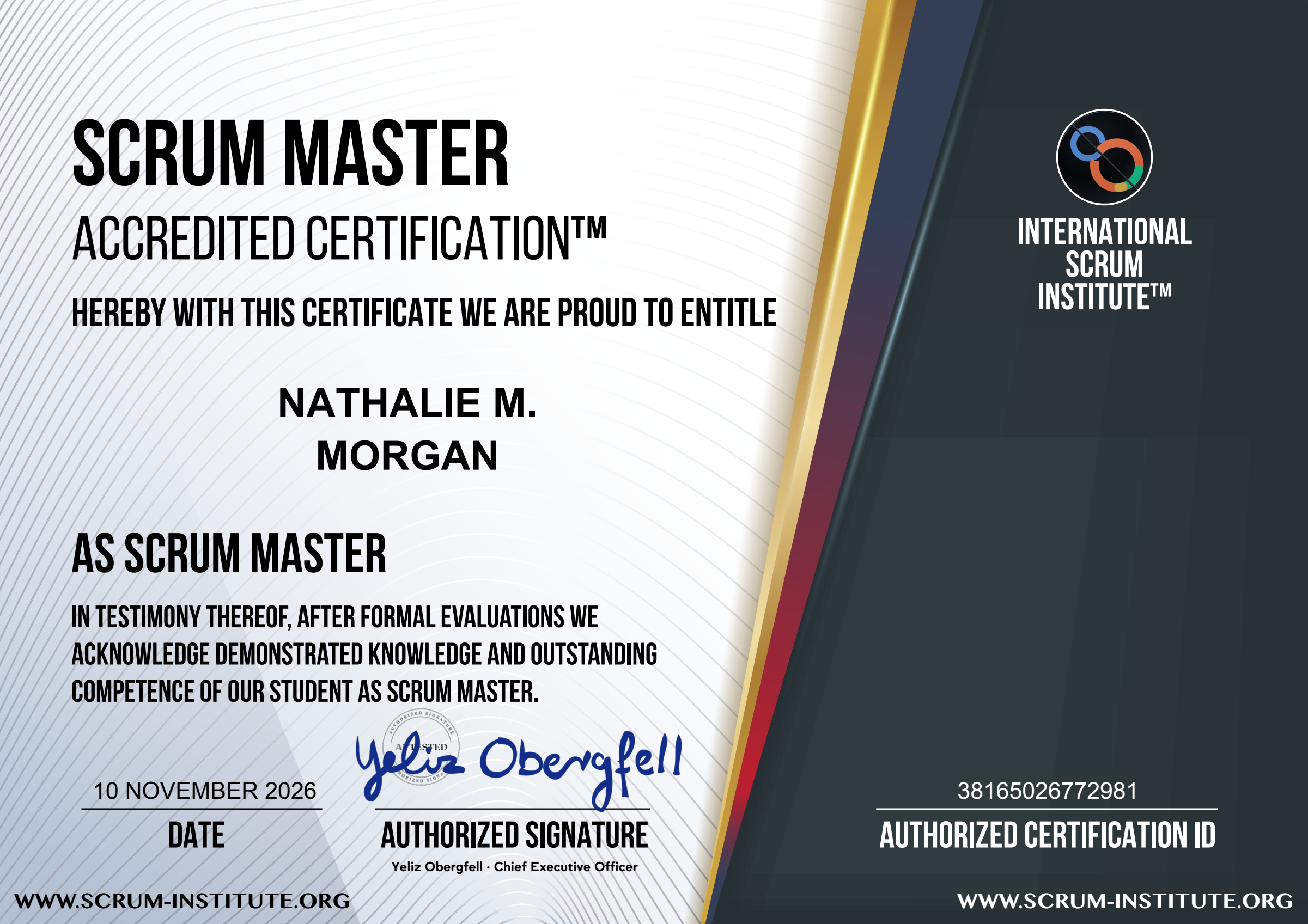
Receive your worldwide-valid certificate and verifiable digital badge.
YOUR FREE PREMIUM ONLINE TRAINING
The Scrum Framework, Third Edition, Is Ready.
We created your training with a consortium of renowned business and people leaders, Scrum and Kanban coaches, mentors, experts and authorities from all major industries. Everyone visiting International Scrum Institute™ can access it. Find the materials through Your Free Scrum Book and Your Free Premium Scrum and Kanban Training in the top menu.
These materials are the copyrighted intellectual property of International Scrum Institute™. We share them freely with everyone because sharing our expertise serves Scrum and Kanban professionals and helps the field develop.
Your certification examination uses multiple-choice questions. Read your online training to build the knowledge you need to pass your examination and earn your Scrum and Kanban Certification.
We guarantee that your free premium online training will make you pass your Scrum and Kanban Certification Exam!